
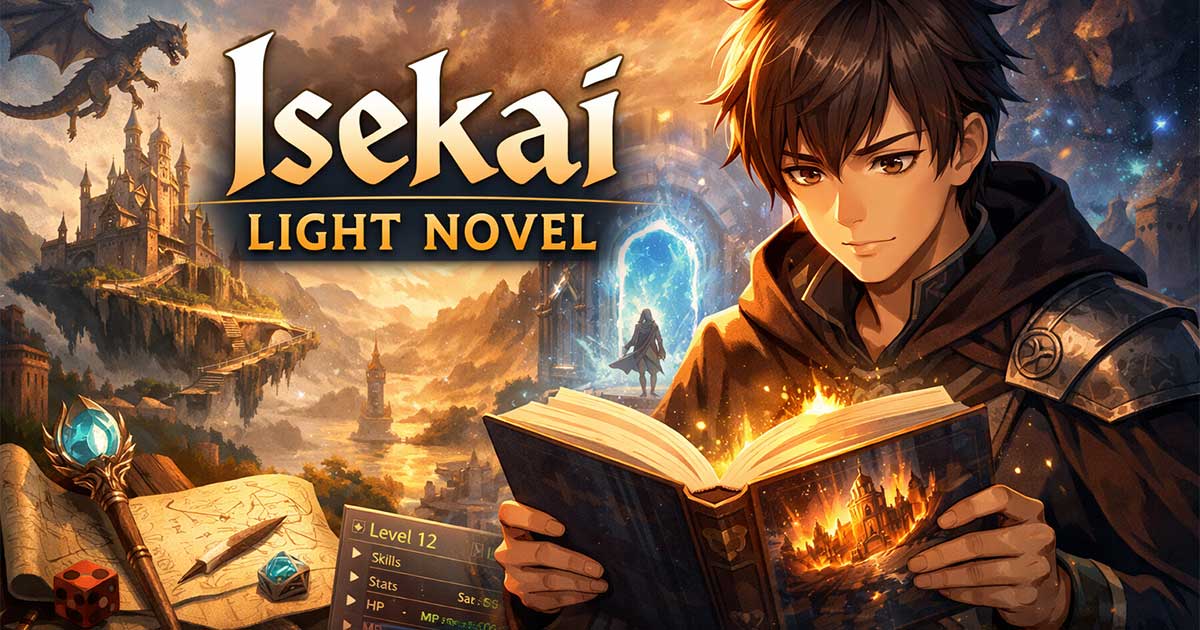
Isekai in Light Novels — Structure, Systems, and Narrative Power
Why Isekai Thrives in Light Novels
Isekai did not simply emerge as a popular genre by coincidence. Its expansion and consolidation are deeply tied to the format that carried it: the light novel.
Unlike traditional novels, light novels operate within a unique narrative ecosystem. They are serialized, fast-paced, visually supported, and often written with a clear awareness of reader feedback. This structure allows experimentation while maintaining accessibility, making them an ideal medium for a concept like isekai.
At its core, isekai revolves around displacement—physical, psychological, and narrative. A character leaves one world and enters another governed by different rules. This transition creates immediate tension, but more importantly, it establishes a framework for growth, adaptation, and transformation.
Light novels amplify this mechanism.
Because they are built around progression and continuity, they allow isekai stories to unfold over long arcs without losing reader engagement. Each volume adds layers: new abilities, new conflicts, new relationships. This gradual expansion aligns perfectly with the expectations of the audience, who anticipate both familiarity and escalation.
In this sense, light novels do not just host isekai—they optimize it.
Narrative Structure and Progression
One of the defining characteristics of isekai in light novels is its structured progression. Unlike standalone narratives, these stories are built to evolve.
The protagonist rarely starts as powerful. Instead, they are introduced in a state of imbalance—socially, physically, or psychologically. This initial weakness is not a limitation but a narrative tool. It creates space for growth.
The progression typically follows a recognizable pattern:
- Arrival in a new world
- Understanding of basic rules
- Acquisition of first abilities or advantages
- Confrontation with localized threats
- Expansion toward larger conflicts
This structure mirrors systems found in role-playing games, but its function is literary rather than mechanical. It gives the reader a clear sense of direction while allowing the author to control pacing.
In light novels, this progression is often quantified. Levels, skills, ranks, and abilities are not merely decorative—they serve as narrative anchors. They make abstract growth visible and measurable, reinforcing the sense of advancement.
However, what distinguishes strong isekai from weaker iterations is not the presence of a system, but how it is integrated. When the system becomes the story, the narrative loses depth. When it supports character development, it enhances it.
The balance between structure and storytelling is what defines the quality of an isekai light novel.
Worldbuilding and Systems
Worldbuilding in isekai is not optional—it is foundational.
The moment a character enters a new world, the reader expects coherence. This world must operate according to rules, even if those rules differ radically from the original reality.
Light novels approach worldbuilding with a specific philosophy: clarity before complexity.
The reader is introduced to the world progressively. Instead of overwhelming exposition, the narrative reveals information through action, dialogue, and consequence. This approach maintains immersion while allowing the world to expand organically.
Key components of isekai worldbuilding include:
- Magic systems or power structures
- Social hierarchies and political tensions
- Economic frameworks
- Cultural norms distinct from the original world
In many cases, the world itself becomes a character. It reacts, resists, and evolves in response to the protagonist’s actions.
Systems play a central role in this process. Whether explicit (levels, stats) or implicit (social influence, magical affinity), they define the boundaries of possibility. They answer a crucial question: what can and cannot be done in this world?
Consistency is critical. A system that changes arbitrarily breaks immersion. A system that is too rigid limits narrative potential. The strength of isekai lies in finding a balance between flexibility and coherence.
Light novels excel at this because their serialized nature allows authors to refine and expand systems over time, adjusting them based on narrative needs and reader reception.
Character Transformation and Identity
At its heart, isekai is not about the world—it is about the character within it.
The transition between worlds creates a rupture in identity. The protagonist is no longer defined by their original environment. They must reconstruct themselves within a new context.
This reconstruction takes multiple forms:
- Adapting to new rules
- Redefining personal goals
- Re-evaluating relationships and values
In light novels, this transformation is often gradual. Each volume contributes to the evolution of the character, allowing readers to witness not just external progress, but internal change.
The isekai framework enables a unique form of introspection. By removing the character from their original world, it strips away preconceived limitations. It creates a space where potential can be explored without the constraints of prior identity.
However, this transformation must be earned.
A character who gains power without struggle risks becoming unrelatable. Conversely, a character who faces challenges and adapts to them creates a stronger emotional connection with the reader.
This balance between empowerment and vulnerability is central to the appeal of isekai in light novels.
Differences from Manga and Anime
While isekai exists across multiple media, its expression in light novels differs significantly from its adaptations in manga and anime.
The most notable difference is depth.
Light novels allow for extensive internal monologue, detailed explanations, and nuanced worldbuilding. They provide access to the protagonist’s thoughts, motivations, and doubts in a way that visual media cannot fully replicate.
Manga and anime, on the other hand, prioritize pacing and visual impact. They condense information, often simplifying complex systems or reducing internal dialogue to maintain flow.
This leads to a shift in emphasis:
- Light novels focus on structure and progression
- Manga emphasizes visual storytelling
- Anime prioritizes rhythm and spectacle
None of these approaches are inherently superior, but they serve different purposes.
For readers seeking a deeper understanding of isekai mechanics—how systems function, how worlds are constructed, how characters evolve—light novels remain the most comprehensive medium.
They offer a level of detail that supports both immersion and analysis.
Why Light Novels Define Modern Isekai
The dominance of isekai in modern storytelling cannot be separated from the rise of light novels.
They provide:
- A flexible format for long-form storytelling
- A direct connection between author and audience
- A structure that supports experimentation and iteration
More importantly, they establish a framework that other media adapt and reinterpret.
Many successful anime and manga originate from light novels. This reinforces their role not just as a medium, but as a foundation.
Isekai, as it exists today, is largely shaped by the conventions and innovations of light novel storytelling.
Conclusion — Beyond the Concept
Isekai is often reduced to a simple premise: being transported to another world.
In light novels, it becomes something more.
It is a system of progression, a framework for worldbuilding, and a mechanism for character transformation. It combines structure and imagination, rules and freedom, familiarity and discovery.
This is why it continues to resonate.
Not because of repetition, but because of its capacity to evolve.
And in that evolution, light novels remain at the center.